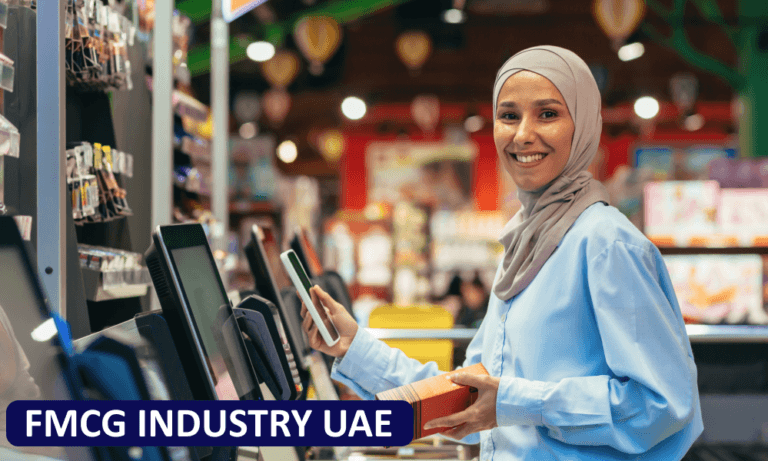


FMCG (Fast-Moving Consumer Goods) recruitment in the UAE is the specialised process of sourcing and placing professionals across sales, marketing, supply chain, trade marketing, and category management functions within food, beverage, personal care, and consumer packaged goods companies operating under UAE trade licences and regulated by the Ministry of Human Resources and Emiratisation (MOHRE), which governs employment conditions in UAE private sector companies under Federal Decree-Law No. 33 of 2021, under Federal Decree-Law No. 33 of 2021. UAE FMCG recruitment differs from general commercial hiring because the sector combines regional headquarters management, distributor-model commercial structures, modern trade relationships with LuLu Hypermarket, Carrefour, and Spinneys, and Emiratisation obligations for private sector headcount above 20 employees. For specialist FMCG recruitment UAE, RFS HR Consultancy places professionals across Dubai, Abu Dhabi, and the wider GCC.
7 Effective FMCG Recruitment Strategies for UAE Employers
- Map the full FMCG talent ecosystem in UAE before opening any brief: active candidates are fewer than the job board volume suggests
- Hire for UAE distributor and modern trade experience specifically, not just FMCG experience from any market
- Build Nafis-eligible UAE national pipelines for Emiratisation-qualifying FMCG roles before quota deadlines arrive
- Use retained search for regional heads, commercial directors, and category management leads where passive candidates dominate
- Run live salary benchmarking against current UAE placements before setting budgets for commercial and marketing roles
- Assess for Arabic language capability for trade marketing, key account, and government relations roles where supplier relationships with UAE retailers require it
- Partner with a FMCG-specialist recruitment agency that has placed in your specific product category, not just the broad consumer goods sector
Why FMCG Recruitment in UAE Requires Specialist Expertise
The UAE FMCG market is structurally different from European or North American FMCG markets in ways that matter for hiring. Most international FMCG companies in the UAE operate through a distributor model rather than direct-to-retail. A Regional Sales Manager who has managed a direct key account relationship with Tesco in the UK has a fundamentally different commercial skill set from one who has managed a distributor network covering Lulu, Carrefour Gulf, and Choithrams simultaneously across multiple GCC markets.
This distinction eliminates a significant proportion of internationally qualified FMCG candidates from genuine relevance to UAE roles. Hiring managers who do not understand this difference, and many international HR teams do not, consistently shortlist candidates who look qualified on paper but lack the specific distributor management and modern trade relationship skills the role actually requires. I have seen regional FMCG hiring processes produce shortlists of eight candidates, none of whom had UAE or GCC distributor experience, because the brief was written against global FMCG competency frameworks rather than the UAE market reality.
1. Map the FMCG Talent Ecosystem Before Opening a Brief
The pool of commercially active FMCG professionals in the UAE with GCC distributor and modern trade experience is smaller than most hiring managers assume. Dubai and Abu Dhabi together hold most of the regional talent pool, and many senior professionals are employed by the same 40 to 60 major FMCG organisations operating regional hubs. A market mapping exercise before the brief opens tells you which companies hold the profiles you need, which candidates are likely to be open to a move, and what salary range the role genuinely requires to attract the right seniority.
Skipping the mapping step and going directly to job board advertising wastes 3 to 5 weeks because the candidates the role actually needs are employed and not watching job boards. The mapping step is also where Emiratisation considerations should be assessed: if the role type qualifies under MOHRE’s occupational classification list for Nafis-eligible positions, a Nafis candidate search runs in parallel with the general market search from day one rather than being added as a compliance afterthought.
2. Hire for UAE and GCC Distributor Experience, Not Generic FMCG
UAE FMCG commercial roles require candidates with direct experience managing authorised distributors, conducting joint business planning with distributor commercial teams, resolving supply chain, pricing, and ranging disputes within distributor agreements, and building sell-through performance in a channel where the brand does not own the customer relationship. These skills develop specifically through UAE or GCC market experience and are not transferable from direct-to-retail markets.
For category management and shopper marketing roles, knowledge of UAE modern trade planogram requirements, promotional compliance frameworks for Lulu and Carrefour Gulf, and awareness of Ramadan and national day promotional cycles is operationally critical. Candidates from markets where these dynamics do not exist require 6 to 12 months of market learning before they perform at the level UAE employers expect at hire.
3. Build Nafis Pipelines for FMCG Emiratisation Roles
FMCG companies in the UAE with 20 or more employees are subject to Emiratisation quotas enforced by MOHRE under Cabinet Resolution No. 18 of 2022. The Nafis federal programme, operated by the Emirati Talent Competitiveness Council, provides wage subsidies of up to 60% of monthly salary for private sector Emirati hires for the first three years of employment. In FMCG, the roles most commonly filled through Emiratisation programmes are sales representative, trade marketing coordinator, key account executive, supply chain analyst, and brand management roles at assistant and junior manager level.
Building a Nafis pipeline for these roles before the compliance deadline requires engagement with UAE national graduates from universities including Abu Dhabi University, American University of Sharjah, and Zayed University, which have active FMCG talent cohorts. A MOHRE-registered Emiratisation specialist with FMCG placement history delivers better candidate quality for these roles than a general FMCG recruiter without Emiratisation programme experience.
4. Use Retained Search for Regional and Commercial Leadership Roles
FMCG regional directors, commercial directors, marketing directors, and supply chain heads in the UAE are almost entirely passive candidates. They are not watching job boards. They are employed, performing at a level that makes them attractive to direct approach, and accessible only through networks built over years of FMCG placement activity in this specific market.
Contingency recruitment for these roles produces inconsistent results because no contingency agency commits the market mapping and direct approach resources required for a passive candidate search when they only earn a fee on success. Retained search, where an upfront commitment funds dedicated research, produces complete market coverage, direct approach to targeted candidates, and a structured shortlist within a defined timeline. The higher fee for retained search on FMCG leadership roles is consistently justified by the quality differential in the shortlist.
5. Benchmark Salaries Against Live UAE FMCG Placements
Salary expectations in UAE FMCG fluctuate significantly with sector demand cycles. Regional hub consolidation, new market entries by global FMCG brands, and talent scarcity in specific categories all push salaries above what published guides reflect. An agency completing 30 to 50 FMCG placements per year in the UAE holds real-time data on offer acceptance rates, counter-offer frequency, and salary movement that no published survey can replicate.
Setting a salary budget for a UAE FMCG commercial role based on global compensation benchmarks or guides published 18 months ago reliably produces offer rejections at the final stage. The candidate was shortlisted, interviewed, and preferred, and then declined the offer because the package was below what their current employer pays or below what competing offers are offering. That outcome is entirely preventable with current local market data.
6. Assess Arabic Language Capability for Customer-Facing Roles
For FMCG trade marketing managers, key account managers covering UAE-owned retailers, and government relations roles involving interactions with Abu Dhabi Department of Economic Development or Dubai Economy and Tourism (DET), Arabic language capability at a professional working level is a genuine differentiator rather than a nice-to-have. UAE-owned retail groups including Lulu Hypermarket and Choithrams conduct supplier negotiations partly or entirely in Arabic at senior levels. Category reviews with UAE government-linked institutions often require Arabic documentation capability.
7. Partner With a FMCG-Specialist Agency, Not a Generalist
The difference between a FMCG-specialist recruitment agency and a generalist agency claiming to cover FMCG is the difference between a recruiter who knows the difference between a Key Account Manager at a Tier 1 modern trade account and a Sales Representative at a distributor, and one who treats both as “sales roles.” That calibration determines shortlist quality, interview pass rates, and first-year retention. Ask any agency claiming FMCG specialist status how many placements they made in consumer goods in the last 12 months, which companies they placed into, and whether the consultant assigned to your brief has placed in your product category. If they cannot answer all three specifically, they are not FMCG specialists.
FMCG Recruitment: UAE vs Other GCC Markets
| Factor | UAE | Saudi Arabia | Kuwait / Qatar |
|---|---|---|---|
| Distributor structure | Mixed: distributor and direct-to-retail in Dubai | National distributors dominant outside Riyadh | Distributor-only in most categories |
| Emiratisation/Saudization | MOHRE quotas under Cabinet Resolution No. 18 of 2022 | HRDF Nitaqat system (Vision 2030 targets) | Kuwaitization/Qatarization programmes in place |
| Language requirement | English primary; Arabic advantage for trade roles | Arabic required for most commercial roles | Arabic required; English for multinational HQs |
| Modern trade access | LuLu, Carrefour Gulf, Spinneys, Choithrams | Panda, Danube, Hyper Panda | Lulu, Sultan Centre, Carrefour |
| Regional HQ location | Dubai dominant | Riyadh growing; Jeddah for FMCG | Secondary market; regional roles based in Dubai |
The 8-Step FMCG Recruitment Process in UAE
An effective FMCG hire in the UAE follows a structured sequence that prevents the most common failure points: wrong candidate profile, salary misalignment, and MOHRE compliance delays.
- Brief intake: confirm job title, seniority, UAE or GCC distributor experience requirement, language requirement, Emiratisation quota status, and salary band based on current market data.
- Market mapping: identify FMCG companies in UAE and GCC holding the right candidate profiles; build a direct approach list before advertising.
- Direct outreach: approach targeted passive candidates directly; advertise in parallel for active candidates where appropriate.
- Screening: assess UAE distributor experience, modern trade knowledge, product category familiarity, and language capability through structured competency interview.
- Nafis check: for Emiratisation-qualifying roles, confirm candidate Nafis registration and quota eligibility before shortlisting.
- Shortlist delivery: present 3 to 5 pre-screened candidates with interview assessment notes within 7 to 10 working days for commercial roles.
- Offer management: advise on UAE-market-competitive package structure, manage negotiation, and confirm acceptance before written offer is issued.
- Onboarding support: track MOHRE visa sequence, Emirates ID, and labour card completion to ensure no delays to the confirmed start date.
Frequently Asked Questions: FMCG Recruitment in UAE
What are the most in-demand FMCG roles in the UAE?
The most consistently in-demand FMCG roles in the UAE are Key Account Manager (modern trade and distributor), Trade Marketing Manager, Category Manager, Supply Chain Manager, Brand Manager, and National Sales Manager. At senior level, Regional Commercial Director and VP Sales roles covering GCC and LEVANT are frequently sourced through Dubai-based search. Emiratisation-qualifying roles at junior and mid-level include sales coordinator, trade marketing analyst, and brand executive, where Nafis-eligible UAE national candidates are actively sought.
How long does FMCG recruitment take in Dubai?
For mid-level commercial roles (Key Account Manager, Trade Marketing Manager) with a specialist FMCG agency, the first shortlist arrives within 7 to 10 working days. Interview and offer processes typically add 2 to 3 weeks for locally based candidates. For regional leadership roles requiring passive candidate search, the full process from brief to offer acceptance runs 8 to 12 weeks. International relocations add 6 to 10 weeks for MOHRE visa and Emirates ID processing before the start date.
What salary should I offer a Key Account Manager in UAE FMCG?
Key Account Manager salaries in UAE FMCG range from AED 15,000 to AED 35,000 per month depending on seniority, product category, and account portfolio. Junior KAMs covering secondary modern trade accounts start at AED 12,000 to AED 18,000. Senior KAMs managing Tier 1 accounts at LuLu or Carrefour Gulf with 5 to 8 years of UAE experience command AED 25,000 to AED 38,000. These figures reflect current live placements and should be used for budgeting rather than published salary surveys, which typically lag by 12 to 18 months in this market.
How does Emiratisation apply to FMCG companies in UAE?
FMCG companies with 20 or more employees on mainland UAE trade licences are subject to MOHRE Emiratisation quotas under Cabinet Resolution No. 18 of 2022. Companies with 50 or more employees must increase their Emirati headcount by 2% of skilled roles annually. Free zone-registered FMCG companies are generally exempt from MOHRE quotas but are encouraged to participate through the Nafis platform. Penalties for non-compliance are AED 6,000 per month per unfilled Emirati position. A MOHRE-registered Emiratisation specialist with FMCG experience builds the pipeline and manages Nafis compliance reporting on your behalf.
What is the difference between FMCG and consumer goods recruitment?
FMCG recruitment focuses specifically on the fast-moving, high-turnover product categories where distributor management, modern trade execution, and promotional agility are the core commercial competencies. Consumer goods recruitment is a broader category that includes durable goods, luxury, fashion, and retail, where the commercial model, margin structure, and route-to-market are fundamentally different. In the UAE, FMCG roles require specific knowledge of the Gulf distributor ecosystem that consumer goods generalists typically lack.
Something worth raising here that sits slightly outside the main FMCG recruitment strategy argument: the halal certification and Shariah compliance knowledge gap in many FMCG leadership hires. For multinational FMCG companies in the Gulf, particularly in food, personal care, and pharmaceutical categories, senior commercial and supply chain leaders need to understand halal certification bodies, Gulf regulatory requirements under ESMA and GSO, and Shariah-compliant product formulation implications. These are specialist requirements that general FMCG recruiters from European backgrounds rarely screen for, while UAE-based FMCG recruiters with Gulf consumer experience include them as standard in their candidate qualification framework.
I would argue that the single most significant FMCG talent gap in the UAE is not at the senior commercial level, where the candidate market is established, but at the mid-level supply chain and category management level. Companies consistently find it harder to hire a Category Manager or S&OP lead with genuine Gulf market exposure than a Country General Manager. The senior roles attract candidates from international FMCG markets that a specialist recruiter with global reach can fill. The mid-level Gulf specialist roles require relationships with a much narrower pool of candidates who have already built Gulf market experience, and that pool is smaller than most hiring managers assume.
Actually, thinking about it more carefully, the framing of FMCG recruitment in the Gulf as a talent shortage problem is probably wrong. The shortage is real, but it is a shortage of candidates with Gulf-specific experience, not a shortage of technically capable FMCG professionals globally. Reframing the brief from finding the best FMCG candidate to finding the best FMCG candidate with Gulf market experience, or the appetite and speed to acquire it, changes the sourcing approach and opens a significantly wider candidate pool.
Find Your Next FMCG Hire Through a UAE Specialist
RFS HR Consultancy places FMCG professionals across commercial, marketing, supply chain, and trade functions in the UAE and wider GCC. Our FMCG recruitment team has placed Key Account Managers, Trade Marketing Directors, Commercial Directors, and Supply Chain leaders in the region’s leading consumer goods businesses. We source for both general commercial roles and Emiratisation-qualifying positions through the Nafis platform.
Related guides:
- Gulf DTC talent challenges for consumer brands
- UAE recruitment trends affecting FMCG hiring
- how a recruitment agency supports FMCG hiring
Visit our FMCG recruitment page to see how we work with consumer goods employers across UAE and GCC. For senior commercial appointments, explore our executive search capability. For Emiratisation pipeline support, visit our Emiratisation recruitment agency page.
Explore related RFS HR Consultancy resources: our executive search firm Dubai UAE for C-suite and director-level placements, Emiratisation recruitment agency UAE for MoHRE quota compliance, UAE salary guide 2025 for compensation benchmarks across all industries, UAE labour law for employers 2025 for Federal Decree-Law No. 33 of 2021 compliance, and recruitment process outsourcing services UAE for high-volume hiring solutions.