

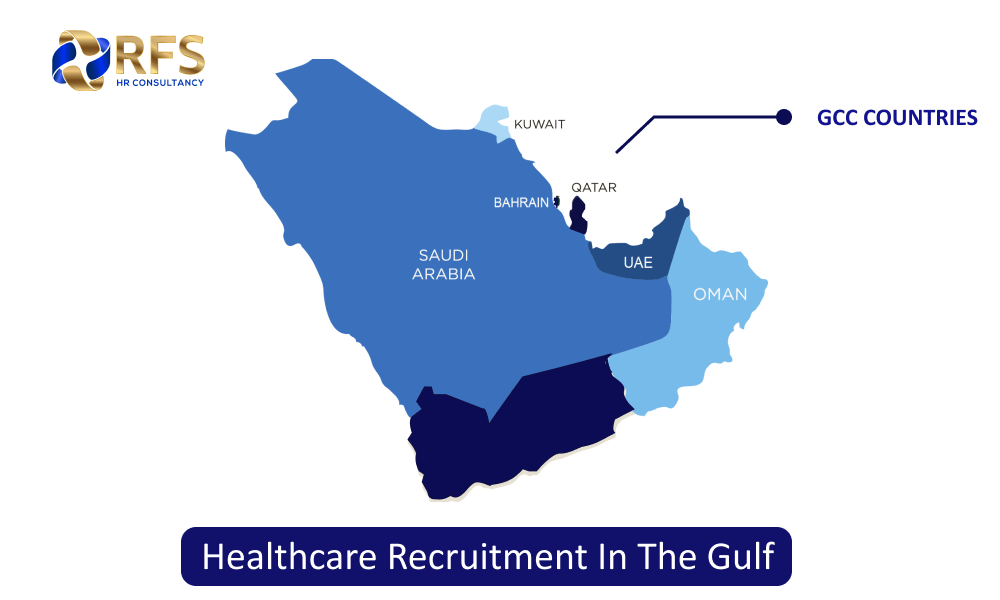
Healthcare recruitment in the Gulf is entering a decade of structural change driven by four forces operating simultaneously: sustained population growth, government-mandated healthcare infrastructure expansion, Emiratisation and Saudization nationalisation agendas that are reshaping who can fill clinical roles, and a global shortage of qualified clinical professionals that makes every GCC country compete in the same international talent market. DHA (Dubai Health Authority) certifies and licenses all healthcare professionals practising in Dubai. DOH (Department of Health Abu Dhabi) governs Abu Dhabi. MOH (Ministry of Health and Prevention) covers the Northern Emirates. In Saudi Arabia, the SCFHS (Saudi Commission for Health Specialties) governs licensing. Understanding how these regulatory bodies interact with the talent supply and demand equation is what separates a strategic healthcare recruitment approach from a reactive one.
The Key Forces Shaping Healthcare Recruitment Across the Gulf
- Healthcare infrastructure expansion — UAE’s National Agenda targets a significant increase in hospital beds and specialist facilities across Dubai and Abu Dhabi. Saudi Arabia’s Vision 2030 healthcare investment programme is driving hundreds of new clinical facility openings through to 2030. Each new facility requires a fully staffed clinical team before it can operate.
- Nationalisation mandates — Emiratisation quotas under MOHRE and Saudization requirements under HRDF (Human Resources Development Fund) are pushing both countries to develop national clinical talent pipelines that are still years from matching the volume demanded by expanding infrastructure.
- International talent competition — the UAE and Saudi Arabia are competing for the same pool of globally qualified clinical professionals as the UK, Australia, Canada, and Germany. GCC salaries remain competitive for expatriate clinicians, but the administrative complexity of Gulf licensing creates a friction that cost-of-living alone cannot always overcome.
- Technology and telehealth — the post-pandemic normalisation of remote consultations and telehealth platforms has created demand for digitally skilled clinical professionals alongside traditional bedside roles, adding a new talent dimension that Gulf healthcare systems are still defining job specifications for.
- Mental health services expansion — both UAE and Saudi Arabia have significantly increased mental health service investment since 2021, creating demand for psychologists, counsellors, and psychiatrists that the regional talent pool cannot currently fill at volume.
The Licensing Complexity That Drives Recruitment Timelines
The single most underestimated factor in Gulf healthcare recruitment is the regulatory licensing timeline. A nurse with impeccable credentials from a reputable international institution cannot practise in Dubai until DHA certifies them through the Sheryan portal, which typically takes four to eight weeks from a complete application. In Abu Dhabi, the DOH process is separate and does not automatically transfer from DHA licensure. In Saudi Arabia, SCFHS certification is a distinct process again. For a healthcare provider expanding across multiple Gulf countries, each market’s licensing system operates independently, which means a candidate hired for a multi-site role may need to navigate three different licensing processes with three different documentation standards.
I have seen healthcare organisations in Dubai plan a new facility opening with a four-week recruitment timeline, discover the DHA licensing process takes 8 to 12 weeks, and open their facility with agency locum cover running at three times the cost of the permanent hires they were waiting for. The licensing timeline is not a problem that recruitment agencies create. It is a fixed regulatory reality. The question is whether your recruitment strategy builds around it or ignores it until it becomes a crisis.
Gulf Healthcare Licensing by Country: A Comparison
| Country / Emirate | Governing Body | Relationship to Practitioners | Typical Licensing Timeline |
|---|---|---|---|
| Dubai | DHA (Dubai Health Authority) | Certifies and licenses all Dubai healthcare professionals via Sheryan portal | 4 to 8 weeks for nurses; 8 to 14 weeks for specialists |
| Abu Dhabi | DOH (Department of Health) | Licenses practitioners in Abu Dhabi facilities; separate from DHA | 6 to 10 weeks depending on speciality |
| Northern Emirates | MOH (Ministry of Health and Prevention) | Governs Sharjah, RAK, Fujairah, Ajman, UAQ clinical professionals | 4 to 8 weeks |
| Saudi Arabia | SCFHS (Saudi Commission for Health Specialties) | Certifies and licenses all healthcare professionals in KSA | 8 to 16 weeks including DataFlow verification |
| Qatar | QCHP (Qatar Council for Healthcare Practitioners) | Governs clinical licensing in Qatar across public and private | 8 to 12 weeks |
Emiratisation in Healthcare: What UAE Hospitals Need to Plan For
MOHRE enforces Emiratisation quotas under Cabinet Resolution No. 18 of 2022, applying to private sector healthcare companies with more than 50 employees. The Nafis (the federal Emiratisation programme for private sector nationals) programme provides wage subsidies for UAE national employees in private sector roles, including healthcare administration, operations, and clinical support functions. The practical challenge for healthcare employers is that the pipeline of DHA-licensed Emirati clinical professionals, particularly nurses and allied health professionals, is still developing relative to the demand created by quota targets and infrastructure expansion simultaneously. The most pragmatic near-term Emiratisation strategy for UAE healthcare organisations focuses on national talent in patient experience, revenue cycle, healthcare administration, and clinical management roles, while building relationships with Emirati nursing and allied health graduates who are still in training.
Something slightly off the main healthcare recruitment argument, but worth naming explicitly: there is a tension between Emiratisation quota targets and the clinical licensing requirements that DHA and DOH enforce. A UAE national who wants to work in clinical healthcare must still meet the same DHA credentialing standards as an expatriate professional. MOHRE’s quota applies to the company’s overall private sector workforce, which means healthcare organisations can meet Emiratisation targets through administrative, operational, and management roles without requiring Emirati nationals to fill clinical positions immediately. This is the more realistic short-term strategy, with clinical Emirati hires becoming a larger proportion of the workforce as the pipeline matures.
Healthcare Roles With the Highest Demand in Gulf Markets
- ICU and critical care nurses — acute shortage across UAE and Saudi Arabia; DHA-licensed ICU nurses with two or more years of Gulf experience command a significant salary premium
- Specialist physicians — cardiology, oncology, neurology, and orthopaedics are consistently among the most in-demand specialities across GCC markets
- Mental health professionals — psychologists, psychiatrists, and counsellors are in acutely short supply relative to expanding demand across both UAE and Saudi Arabia
- Radiographers and medical imaging specialists — driven by investment in diagnostic infrastructure across Dubai’s growing private hospital network
- Healthcare administrators and operations managers — particularly those with experience managing multi-site clinical operations in a Gulf regulatory environment
- Telehealth-enabled clinicians — GPs and specialist consultants with experience in digital consultation platforms and remote patient management
How to Build a Future-Ready Healthcare Recruitment Strategy in the Gulf
- Map your clinical headcount needs 12 to 18 months ahead, accounting for DHA and DOH licensing timelines rather than just vacancy dates
- Build relationships with healthcare recruitment agencies that have specialist licensing support infrastructure, not just candidate databases
- Develop an Emirati talent pipeline through partnerships with UAE healthcare education institutions, well before quota deadlines require it
- Register with Nafis to access wage subsidies for UAE national hires in administration, operations, and clinical management roles
- Introduce RPO (Recruitment Process Outsourcing) for volume clinical hiring programmes, where a dedicated agency team manages sourcing, screening, and DHA application support as a unified process
- Build your employer brand in international clinical talent markets, particularly South Asia and the Philippines, where the majority of UAE’s expatriate nursing workforce originates
- Create a structured locum and contract staffing strategy to cover licensing gaps between offer acceptance and DHA/DOH licensure confirmation
- Review your clinical onboarding programme to ensure new hires reach full clinical scope of practice within 90 days of their licence being confirmed
My view, and this contradicts the prevailing approach at many Gulf healthcare organisations: the solution to Gulf healthcare talent shortages is not primarily a sourcing problem. It is an employer brand and retention problem. The UAE and Saudi Arabia attract large volumes of qualified clinical professionals every year. The organisations that lose them within 18 months are the ones with poor management cultures, inadequate professional development, and administrative processes that make clinical life harder than it needs to be. Fix retention and your sourcing costs halve within two years.
Frequently Asked Questions: Healthcare Recruitment Across UAE, Saudi Arabia, and Gulf States
Why is healthcare recruitment in the Gulf so challenging?
The core challenges are regulatory, competitive, and structural simultaneously. Regulatory: DHA, DOH, MOH, and SCFHS each run separate licensing systems with different documentation requirements and timelines, creating administrative complexity that slows placement even when the candidate is qualified. Competitive: every GCC country is competing for the same internationally qualified clinical professionals as Western markets that also offer significant lifestyle advantages. Structural: Emiratisation and Saudization mandates are increasing the demand for national clinical talent at a rate that the UAE and Saudi educational systems have not yet matched in output.
How long does it take to hire a specialist physician for a UAE hospital?
For a specialist physician position in a UAE hospital, the full process from brief to first day in post typically takes 16 to 24 weeks. A specialist healthcare recruiter should deliver a shortlist within 14 working days. Client interviews, offer negotiation, and acceptance typically add 3 to 4 weeks. The DHA licensing and DataFlow primary source verification process for specialist physicians then takes 8 to 14 weeks from complete application submission. Employers who do not factor the licensing timeline into their resource planning end up with a vacancy for four to six months longer than they expected.
How does Saudization affect healthcare recruitment in Saudi Arabia?
Saudi Arabia’s Nitaqat (the MHRSD (Ministry of Human Resources and Social Development, Saudi Arabia)-administered Saudization quota system) system, enforced by HRDF (Human Resources Development Fund), categorises companies by their Saudization compliance level across different industry sectors. Healthcare companies in the Platinum or Green category can sponsor expatriate workers more easily than those in lower categories. The SCFHS licensing requirement for all clinical professionals, combined with Saudization targets for clinical administration and management roles, creates a dual compliance challenge for international healthcare employers setting up in KSA. Agencies with experience in both SCFHS licensing support and Saudization planning save significant time for international healthcare operators entering the Saudi market.
What is the best recruitment model for a new hospital opening in Dubai or Abu Dhabi?
For a new hospital or clinic opening in Dubai or Abu Dhabi that needs to hire 20 or more clinical staff within a defined window, an RPO model with a specialist healthcare agency is the most effective approach. The RPO arrangement provides a dedicated recruitment team with DHA or DOH licensing support, a structured sourcing and assessment process, and volume-adjusted cost-per-hire that is typically 30 to 40 percent lower than using multiple general agencies in parallel. Start the RPO engagement at least 12 months before the planned opening date to allow for DHA/DOH licensing timelines for all clinical roles.
Actually, I want to revisit the technology and telehealth framing. The Gulf healthcare market is often described as behind on digital adoption. That was true in 2018. It is much less true now. The UAE’s DHA has an active telehealth licensing framework, and several Abu Dhabi-based healthcare operators have telehealth platforms that are technically ahead of equivalents in UK primary care. The recruitment implication is not that Gulf employers need to educate international candidates about telehealth. It is that Gulf employers recruiting from markets where telehealth is still emerging will find their candidates less prepared than they expect.
Further Reading: Healthcare Recruitment Across Gulf Markets
For a detailed view of how healthcare recruitment agencies in Dubai operate and how to choose the right one, read our guide to healthcare recruitment agencies in Dubai. For the top recruitment challenges that healthcare organisations face across the Gulf, see our post on healthcare industry recruitment strategies. And for how the RPO model applies to volume healthcare hiring programmes, read our RPO efficiency guide.
If you are planning a healthcare expansion in Dubai, Abu Dhabi, or across the Gulf and need a recruitment partner with clinical licensing expertise, talk to the RFS team. Visit our healthcare recruitment page to get started.